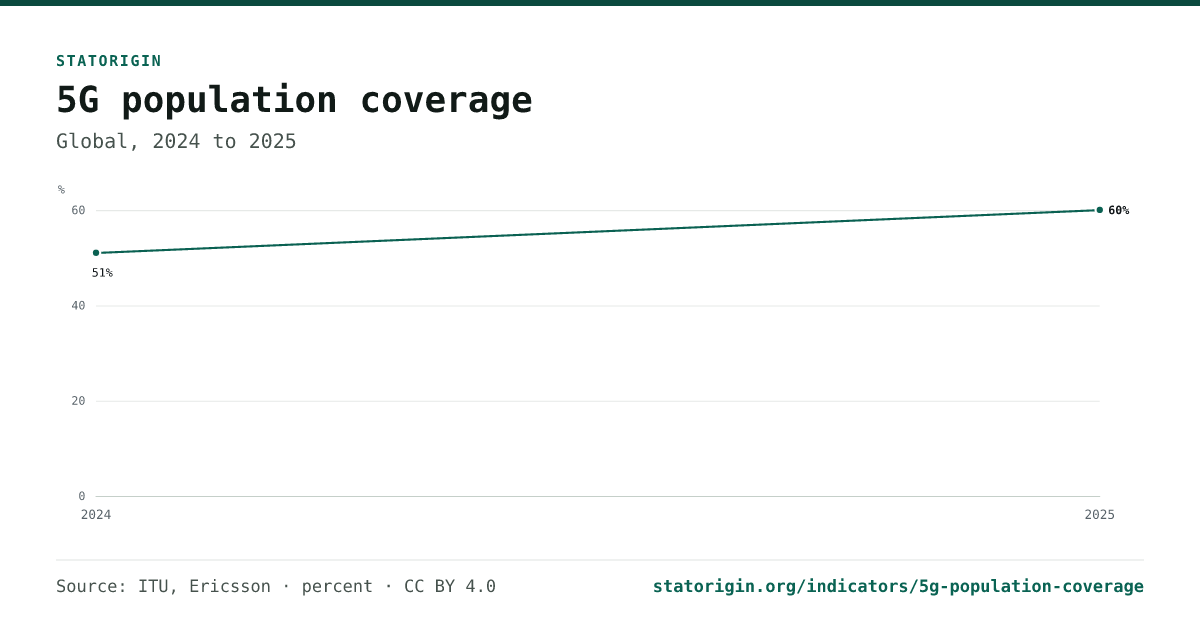
Over time
Global over time, then selected latest values by region. Forecasts are dashed with hollow markers; the underlying values are one click away under the chart.
5G population coverage
Global, 2024 to 2025
Estimates are listed as such in the table below
5G population coverage by region
Latest value per region, 2025
Estimate
Every record
4 records · 2 regions · 2024–2025. Each period links to its record: the value, its source evidence and original document.
Download this data
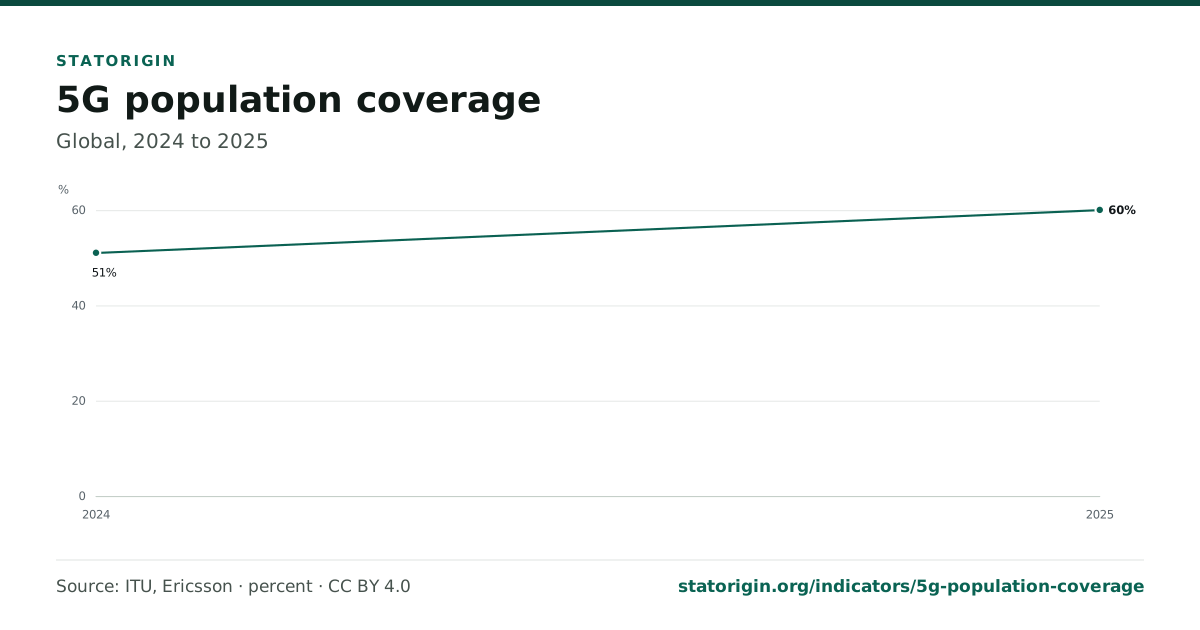
Every file carries its provenance: the CSV has a source column per row, and the chart images print the publisher, the licence and this page's address under the drawing. Source: ITU and Ericsson. Licence: CC BY 4.0.
Embed this chart
For automatic sizing and multiple charts, see the JavaScript embed guide.
Free to embed anywhere, including commercially. The attribution bar is part of the chart. The link under the frame is optional: keep it, remove it or mark it rel="nofollow".
Use and publication rights
- View, cite and link: free
Quote any number, cite this page or a single record, and link to it anywhere.
- Copy, chart and republish: free with attribution
The data is published under CC BY 4.0, commercial use included. Credit StatOrigin and the original publisher (ITU and Ericsson); the chart files already carry that line.
- The source documents: the publisher's terms
Figures are facts read from the publishers' own documents. The documents themselves, their text and design, stay under each publisher's terms; follow the source links for those.
How this measure is built
- Definition
- Share of the region's population living within range of a 5G mobile network signal.
- Measure
- One slice of Network population coverage ( form: share, segment: 5g ) . Percentage of the population living within range of a mobile network signal. Region and period are columns on every record, not slices.
- Limitations
- Values are shown as published; StatOrigin does not revise, fill gaps or convert currencies.
- Verification
- Each value, unit, period and place was checked against its source evidence before publication. See the methodology and the corrections process.
Sources · 3 documents
| Document | Publisher | Published | Data points |
|---|---|---|---|
| Measuring digital development: Facts and Figures 2025 - Mobile network coverage | ITU | 17 Nov 2025 | 2 |
| Measuring digital development: Facts and Figures 2024 - Mobile network coverage | ITU | 27 Nov 2024 | 1 |
| Ericsson Mobility Report June 2026 - Network coverage outlook | Ericsson | 16 Jun 2026 | 1 |
Other slices of network population coverage
- 4G population coverage 3 4g
- 5G mid-band population coverage outside mainland China 1 5g mid band
- 5G population coverage, high-income countries 1 5g high income
- 5G population coverage, low-income countries 1 5g low income
- 5G population coverage, rural areas 1 5g rural
- 5G population coverage, urban areas 1 5g urban
- Mobile broadband (3G or better) population coverage 1 3g or better
Frequently asked questions
What is the latest 5G population coverage?
Global: 60% in 2025, +9.0 pp on 2024.
Where does this data come from?
From 3 documents published by ITU and Ericsson. Every figure on this page links to its record, which preserves the original source evidence.
How often is it updated?
Annual. The newest published period is 2025; the next release should cover 2026. A new figure appears here once the publisher releases it and it passes verification.
Can I use this data?
Yes. StatOrigin publishes it under CC BY 4.0: you may copy, chart and republish it, including commercially, with attribution to StatOrigin and to the original publisher.
Cite this page
Cite the page as a data set, or open any record to cite one figure: each record carries APA, MLA, Chicago and BibTeX forms that credit the original publisher.
StatOrigin. (2026). 5G population coverage [Data set]. Retrieved October 28, 2026, from https://statorigin.org/indicators/5g-population-coverage
"5G population coverage." StatOrigin, 2026, https://statorigin.org/indicators/5g-population-coverage. Accessed 28 Oct. 2026.
StatOrigin. "5G population coverage." Data set, 2026. Accessed October 28, 2026. https://statorigin.org/indicators/5g-population-coverage.
@misc{statorigin_5g_population_coverage_2026, title = {5G population coverage}, author = {{StatOrigin}}, year = {2026}, url = {https://statorigin.org/indicators/5g-population-coverage}, note = {Data set. Accessed 2026-10-28} }