TOPIC_ECONOMY · Economy · 171 regions
Gini index
Guatemala had the highest gini index in 2023, at 45.2 index, ahead of Turkiye (43.7 index) and El Salvador (39.8 index). United States: 41.8 index in 2024, +0.0% on 2023.
- 41.8 index Latest · United States · 2024
- +0.0% vs 2023
- Annual Release cadence
- 2,381 Records · 171 regions · 1980–2024
Verified 2 Oct 2026 · 1 publisher · Next period 2025
By region
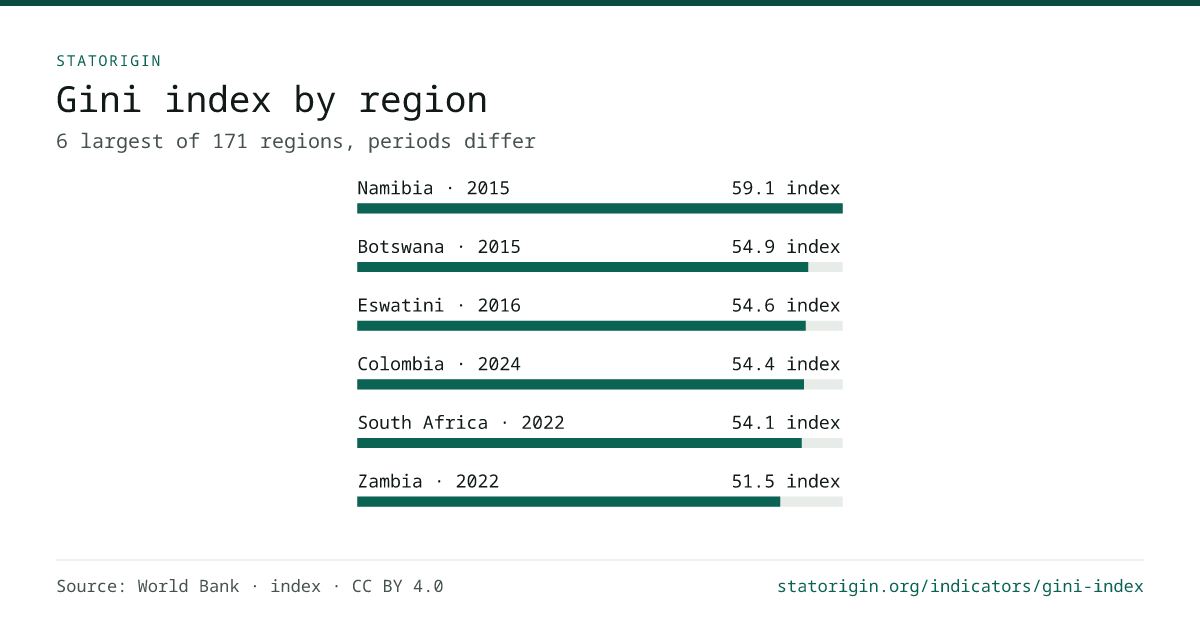
Each region's latest published value, the 6 largest of 171. Periods differ where publishers release on different schedules; the period sits under each name.
Gini index by region
6 largest of 171 regions, periods differ
Latest available period per row; years differ.
Record preview
2,381 records · 171 regions · 1980–2024. Each period links to its record: the value, its source evidence and original document.
Showing 6 recent records from the first 6 regions in the overview. Download all 2381 records (CSV) or read a regional JSON series.
| Period | Value | Source | Type |
|---|---|---|---|
| Namibia 1 record | |||
| 2015 | 59.1 index | World Bank · 31 Dec 2015 | |
| Botswana 1 record | |||
| 2015 | 54.9 index | World Bank · 31 Dec 2015 | |
| Eswatini 1 record | |||
| 2016 | 54.6 index | World Bank · 31 Dec 2016 | |
| Colombia 1 record | |||
| 2024 | 54.4 index | World Bank · 31 Dec 2024 | |
| South Africa 1 record | |||
| 2022 | 54.1 index | World Bank · 31 Dec 2022 | |
| Zambia 1 record | |||
| 2022 | 51.5 index | World Bank · 31 Dec 2022 | |
Explore by country
Open a country for its time series and source records. Countries with fewer than three records link to their JSON series.
- Albania
- Algeria
- Angola
- Argentina
- Armenia
- Australia
- Austria
- Azerbaijan
- Bangladesh
- Barbados
- Belarus
- Belgium
- Belize
- Benin
- Bhutan
- Bolivia
- Bosnia and Herzegovina
- Botswana
- Brazil
- Bulgaria
- Burkina Faso
- Burundi
- Cabo Verde
- Cameroon
- Canada
- Central African Republic
- Chad
- Chile
- China
- Colombia
- Comoros
- Congo
- Costa Rica
- Cote d'Ivoire
- Croatia
- Cyprus
- Czechia
- Democratic Republic of the Congo
- Denmark
- Djibouti
- Dominican Republic
- Ecuador
- Egypt
- El Salvador
- Equatorial Guinea
- Estonia
- Eswatini
- Ethiopia
- Fiji
- Finland
- France
- Gabon
- Gambia
- Georgia
- Germany
- Ghana
- Greece
- Grenada
- Guatemala
- Guinea
- Guinea-Bissau
- Guyana
- Haiti
- Honduras
- Hungary
- Iceland
- India
- Indonesia
- Iran
- Iraq
- Ireland
- Israel
- Italy
- Jamaica
- Japan
- Jordan
- Kazakhstan
- Kenya
- Kiribati
- Kosovo
- Kyrgyzstan
- Laos
- Latvia
- Lebanon
- Lesotho
- Liberia
- Lithuania
- Luxembourg
- Madagascar
- Malawi
- Malaysia
- Maldives
- Mali
- Malta
- Marshall Islands
- Mauritania
- Mauritius
- Mexico
- Micronesia
- Moldova
- Mongolia
- Montenegro
- Morocco
- Mozambique
- Myanmar
- Namibia
- Nauru
- Nepal
- Netherlands
- Nicaragua
- Niger
- Nigeria
- North Macedonia
- Norway
- Pakistan
- Palestine
- Panama
- Papua New Guinea
- Paraguay
- Peru
- Philippines
- Poland
- Portugal
- Qatar
- Romania
- Russia
- Rwanda
- Saint Lucia
- Samoa
- Sao Tome and Principe
- Senegal
- Serbia
- Seychelles
- Sierra Leone
- Slovakia
- Slovenia
- Solomon Islands
- South Africa
- South Korea
- South Sudan
- Spain
- Sri Lanka
- Sudan
- Suriname
- Sweden
- Switzerland
- Syria
- Tajikistan
- Tanzania
- Thailand
- Timor-Leste
- Togo
- Tonga
- Trinidad and Tobago
- Tunisia
- Turkiye
- Turkmenistan
- Tuvalu
- Uganda
- Ukraine
- United Arab Emirates
- United Kingdom
- United States
- Uruguay
- Uzbekistan
- Vanuatu
- Venezuela
- Vietnam
- Yemen
- Zambia
- Zimbabwe
Download this data
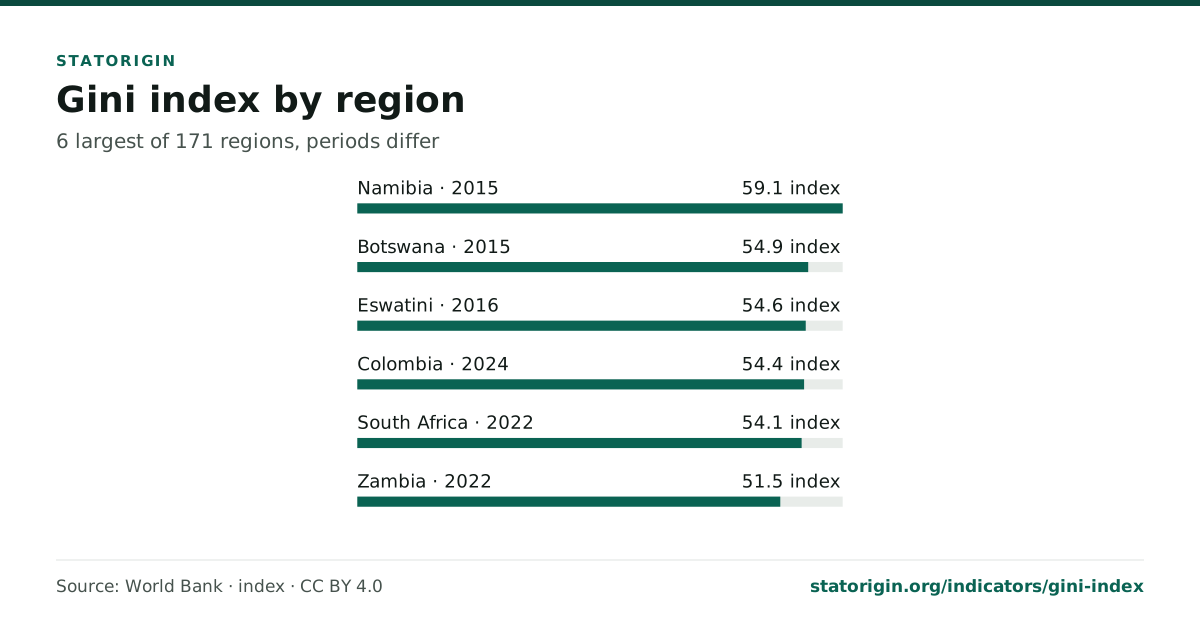
Every file carries its provenance: the CSV has a source column per row, and the chart images print the publisher, the licence and this page's address under the drawing. Source: World Bank. Licence: CC BY 4.0.
Use and publication rights
- View, cite and link: free
Quote any number, cite this page or a single record, and link to it anywhere.
- Copy, chart and republish: free with attribution
The data is published under CC BY 4.0, commercial use included. Credit StatOrigin and the original publisher (World Bank); the chart files already carry that line.
- The source documents: the publisher's terms
Figures are facts read from the publishers' own documents. The documents themselves, their text and design, stay under each publisher's terms; follow the source links for those.
How this measure is built
- Definition
- Gini index measures the extent to which the distribution of income or consumption expenditure among individuals or households within an economy deviates from a perfectly equal distribution.
- Measure
- One slice of Gini index ( form: level ) . Measure of the distribution of income across a population, ranging from 0 (perfect equality) to 100 (perfect inequality). Region and period are columns on every record, not slices.
- Limitations
- Publishers release on different schedules, so the latest period differs by region; compare regions on the same period. Values are shown as published; StatOrigin does not revise, fill gaps or convert currencies.
- Verification
- Each value, unit, period and place was checked against its source evidence before publication. See the methodology and the corrections process.
Sources · 1 document
| Document | Publisher | Published | Data points |
|---|---|---|---|
| World Bank Gini index | World Bank | — | 2381 |
Frequently asked questions
What is the latest gini index?
Guatemala had the highest gini index in 2023, at 45.2 index, ahead of Turkiye (43.7 index) and El Salvador (39.8 index). United States: 41.8 index in 2024, +0.0% on 2023.
Which country has the highest gini index?
Guatemala, at 45.2 index in 2023. 37 countries published figures for that period.
Where does this data come from?
From 1 document published by World Bank. Every figure on this page links to its record, which quotes the sentence or table row the number was read from.
How often is it updated?
Annual. The newest published period is 2024; the next release should cover 2025. A new figure appears here once the publisher releases it and it passes verification.
Can I use this data?
Yes. StatOrigin publishes it under CC BY 4.0: you may copy, chart and republish it, including commercially, with attribution to StatOrigin and to the original publisher.
Cite this page
Cite the page as a data set, or open any record to cite one figure: each record carries APA, MLA, Chicago and BibTeX forms that credit the original publisher.
StatOrigin. (2026). Gini index [Data set]. Retrieved October 2, 2026, from https://statorigin.org/indicators/gini-index
"Gini index." StatOrigin, 2026, https://statorigin.org/indicators/gini-index. Accessed 2 Oct. 2026.
StatOrigin. "Gini index." Data set, 2026. Accessed October 2, 2026. https://statorigin.org/indicators/gini-index.
@misc{statorigin_gini_index_2026, title = {Gini index}, author = {{StatOrigin}}, year = {2026}, url = {https://statorigin.org/indicators/gini-index}, note = {Data set. Accessed 2026-10-02} }